

Chapter 1
—————
Not a bad ration for a couple of raisin farmers from Cali.
- His Military Buddies
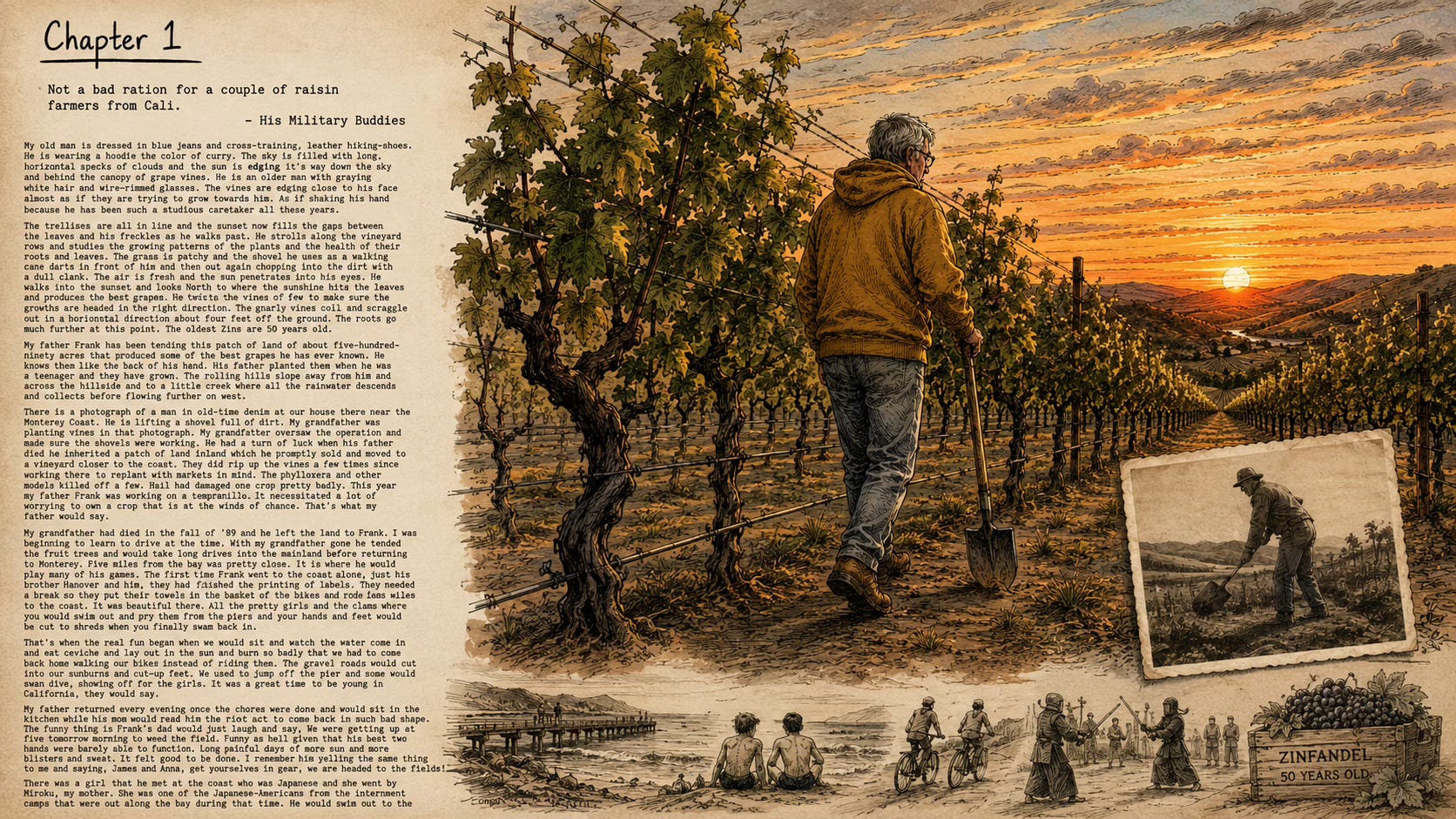
My old man is dressed in blue jeans and cross-training, leather hiking-shoes. He is wearing a hoodie the color of curry. The sky is filled with long, horizontal specks of clouds and the sun is edging it’s way down the sky and behind the canopy of grape vines. He is an older man with graying white hair and wire-rimmed glasses. The vines are edging close to his face almost as if they are trying to grow towards him. As if shaking his hand because he has been such a studious caretaker all these years.
The trellises are all in line and the sunset now fills the gaps between the leaves and his freckles as he walks past. He strolls along the vineyard rows and studies the growing patterns of the plants and the health of their roots and leaves. The grass is patchy and the shovel he uses as a walking cane darts in front of him and then out again chopping into the dirt with a dull clank. The air is fresh and the sun penetrates into his eyes. He walks into the sunset and looks North to where the sunshine hits the leaves and produces the best grapes. He twists the vines of few to make sure the growths are headed in the right direction. The gnarly vines coil and scraggle up the stakes and the branches grip tightly to the trellis wires stretched out in a horizontal direction about four feet off the ground. The roots go much further at this point. The oldest Zins are 50 years old.
My father Frank has been tending this patch of land of about five-hundred-ninety acres that produced some of the best grapes he has ever known. He knows them like the back of his hand. His father planted them when he was a teenager and they have grown. The rolling hills slope away from him and across the hillside and to a little creek where all the rainwater descends and collects before flowing further on west.
There is a photograph of a man in old-time denim at our house there near the Monterey Coast. He is lifting a shovel full of dirt. My grandfather was planting vines in that photograph. My grandfather oversaw the operation and made sure the shovels were working. He had a turn of luck when his father died he inherited a patch of land inland which he promptly sold and moved to a vineyard closer to the coast. They did rip up the vines a few times since working there to replant with markets in mind. The phylloxera and other models killed off a few. Hail had damaged one crop pretty badly. This year my father Frank was working on a tempranillo. It necessitated a lot of worrying to own a crop that is at the winds of chance. That’s what my father would say.
My grandfather had died in the fall of ‘89 and he left the land to Frank. I was beginning to learn to drive at the time. With my grandfather gone he tended the fruit trees and would take long drives into the mainland before returning to Monterey. Five miles from the bay was pretty close. It is where he would play many of his games. The first time Frank went to the coast alone, just his brother Hanover and him, they had finished the printing of labels. They needed a break so they put their towels in the basket of the bikes and rode five miles to the coast. It was beautiful there. All the pretty girls and the clams where you would swim out and pry them from the piers and your hands and feet would be cut to shreds when you finally swam back in.
That’s when the real fun began when we would sit and watch the water come in and eat ceviche and lay out in the sun and burn so badly that we had to come back home walking our bikes instead of riding them. The gravel roads would cut into our sunburns and cut-up feet. We used to jump off the pier and some would swan dive, showing off for the girls. It was a great time to be young in California, they would say.
My father returned every evening once the chores were done and would sit in the kitchen while his mom would read him the riot act to come back in such bad shape. The funny thing is Frank’s dad would just laugh and say, We were getting up at five tomorrow morning to weed the field. Funny as hell given that his best two hands were barely able to function. Long painful days of more sun and more blisters and sweat. It felt good to be done. I remember him yelling the same thing to me and saying, James and Anna, get yourselves in gear, we are headed to the fields!
There was a girl that he met at the coast who was Japanese and she went by Miroku, my mother. She was one of the Japanese-Americans from the neighborhoods that were out along the bay during that time. He would swim out to the makeshift pier in the bay and practice kendo with them, swinging swords and wearing hot padding. Sometimes he didn’t use padding and my grandmother would again complain thinking he was getting into trouble. He was ok though. You would just sleep it off and be in the vineyard the next day. It was great to be alive.
They used to walk along the beach and collect stones and shells. The girl was small, about five feet tall, very petite and she had the greatest little features. She was dainty and her father hated that my father would even look at her. But he said nothing because they were in love. She would sing to him at night and he would have to swim all the way back to the shore and bike home long after it was dark. His mother would ground him for the next three days but it wouldn’t matter. My grandfather would always allow him to go the next morning by saying, Sure kiddo! Find me a pearl!, after finishing his cigar and cognac before going to bed. I still remember the smell of his cigars all the way to college after he died. He died of a heart attack and some thought it was because of the amount he smoked and drank. I knew it was because he was just ready to die when he did. It had been a good time to check out as he called it.
My father was a nice guy but very grounded and practical. He was the one that did things with us kids. He showed us the same spots he used to swim at the pier and the ice cream shop in the little market that was nearby. He kept us isolated during the week, straying in the evenings only a mile or two but never to the coast. When he died that all changed.
My mother had a hard time keeping track of us and eventually conceded that we were adults and had as much right to freedom as anyone and that was the start of the real mother she became. My mother was a great woman. She had cropped and tied up hair and a pearl necklace she had gotten from Frank’s father.. They had come over from the midwest during the depression. They were one of the success stories, selling the dairy farm and heading out west.
They went by motor carriage and he had owned a farm since his grandfather had come over from Ireland. He went to Ireland once too in search of his granddaughter but never was able to find her. My grandfather wanted to connect with the land he had come from but it was foreign and he came home early. He had learned a lot about the land and traveling across country by train and then by boat to Ireland.
My grandfather returned from Ireland and set up shop in the midwest buying up a bunch of dairy cows and selling their milk and cheese. He often bred them too once he found that they had quality. So when they moved out to Monterey they were delighted to be getting away and knew that their business would sell for a great price and it did. That’s when they found out that the thing they wanted most was children and that if they didn’t have any they would be sad in later life. The little stone house I later made for myself in Michigan was a voyage to get closer to where we originally came from in the MidWest.
The house on Monterey was nice and my father found it peaceful to tend to his grapes and see the splendor of making wine. They really loved the whole thing: the agriculture, the viniculture, the enology.
When their family would visit they would snaz up the joint with some real jazz and some great brandy which they also made. They were lucky though; not all the people trying to make it did and Monterey County was certainly not Napa. They found connections all over the place with other sellers and wineries. They were all competing but the market opened up and all were selling wines out east, Europe and places like that, long after the dairy farm would have produced a great profit.
***
Our neighbor Hanover, my Uncle, was in line to inherit a seperate vineyard and winery next to my immediate families’ that my grandfather had bought for my aunt’s inheritance. Monterery was an up and coming place and he wanted to stay near the ocean so he bought this new plot which had better inland airflow but also was closer to the ocean where his kids could play. And they did. He had two sons and a daughter each were 18, 20 and 24. They all were living close; both his son Andrew and Sarah were both living on the property. Their house was a replica of the Haut Brion house in France.
Their mother was my mother’s sister and as such Japanese-American as well. We thought their story was one of great courage and wonderment. How their mother had been wronged by the government when Japan hit the coast of Hawaii. We were all afraid because the raid meant not only were her sons to be in the army but that perhaps Japan would hit the actual coast of California and do some major damage to it.
We launched a campaign that fucked them up in the end but many friends and relatives of his were killed in that war. My grandfather’s cousin had actually died in the Pearl Harbor attacks. My grandfather was too old to serve but his sons were the right age to be shipped out and they did even though they could have been granted agricultural exemption. They would bring their friends and they would all stay over and laugh and drink wine and beer and have a great time with everything. Both my father and my uncle flew airplanes over Japan. They stayed together as brothers and flew side by side in combat. Both watching out for each other at all costs. They were very fortunate to be given the chance to fly for their country and had at least ten kills apiece. Not a bad ration for a couple of raisin farmers from Cali, they used to say.
My father lifted his head and began walking again in the direction of the châlet. Their little Monterey farm had grown from about fifty acres to over five hundred since he took over. This would be left for me and my sister Anna. This would be the place in which they would really own their hearts and come to family dinners and eat there as part of the tradition for a long time to come. His grandchildren would be lovely and well fed too.
But things don’t always play out the way parents intend. The traditions live on in the wine, food and family; be it divorced from place.
* * *