

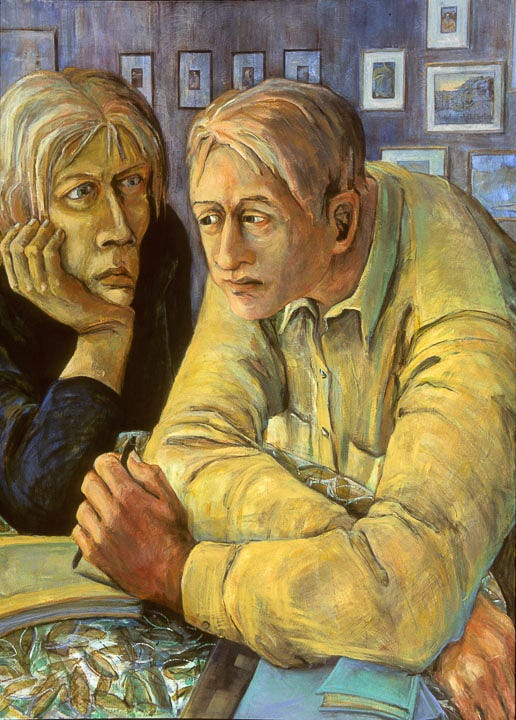
My mother, Eve Whitaker, made Two People, Books and Pen with the two figures based on her and me…I think, if adjacently. Looking at the painting now, I see more than a double portrait. I see an image of our artistic relationship—and perhaps something about what it means for one artist to raise another.
The body language is important. My mother sits on the left, her head resting heavily against her hand. She is still and observant. Her attention seems directed toward me. I occupy more of the foreground, leaning across the table, but I am looking somewhere else.
That creates a quiet movement through the painting: mother to son to something outside the picture.
Between and beneath us are books, papers and a pen. They suggest knowledge, writing, education and artistic tradition—the accumulated material one generation can give another. Yet neither of us is actually looking at them. They are simply there, part of the environment we share.
I think that distinction matters.
My mother did not teach me to make her work. She gave me a place in which making art was ordinary and serious. Art was something people did, argued about, studied and continued doing over a lifetime. The materials on the table could therefore be understood less as instructions than as an inheritance.
The painting also contains an interesting reversal. My mother is the older artist, but she is not shown instructing me. She watches. Her dark clothing pulls her somewhat into the background while my yellow shirt pushes forward into the light. I am physically closer to the books and papers, but my attention has already moved elsewhere.
There is no triumph in that movement. My expression is uncertain and absorbed. Artistic inheritance can be a gift, but it can also present a problem: What are you supposed to do with everything you have been given?
Our work eventually moved in markedly different directions. My mother’s work often concentrates on human relationships and emotional interactions through figures—the ways people watch, hold, confront, protect or withdraw from one another. My own work has increasingly dispersed those relationships across drawing, text, musical notation and systems.
Seen retrospectively, Two People, Books and Pen seems almost to anticipate that divergence.
She is looking at the relationship.
I am looking beyond it.
That does not mean rejecting what came before. Quite the opposite. The books and pen remain on the table. The inheritance remains present. But inheritance between artists does not have to mean stylistic imitation. Perhaps its more important function is to provide something solid enough to depart from.
I cannot know exactly what my mother intended the painting to say about us. But looking at it now, I find a possibility that feels true:
I gave you a place inside an artistic inheritance. I watch you closely, but I do not expect you to become me. The books, images and tools are between us and belong to both of us. What you make from them is yours.
For a family of artists, that may be one of the most important forms of inheritance: not the transmission of a style, but the permission to continue differently.