

Solomon’s work feels like an inheritor or reinterpretation of Eve’s rather than a direct stylistic imitation. Both organize crowded social space through compression, angular figuration, and psychological tension, but they diverge sharply in how they handle structure, temporality, and atmosphere.
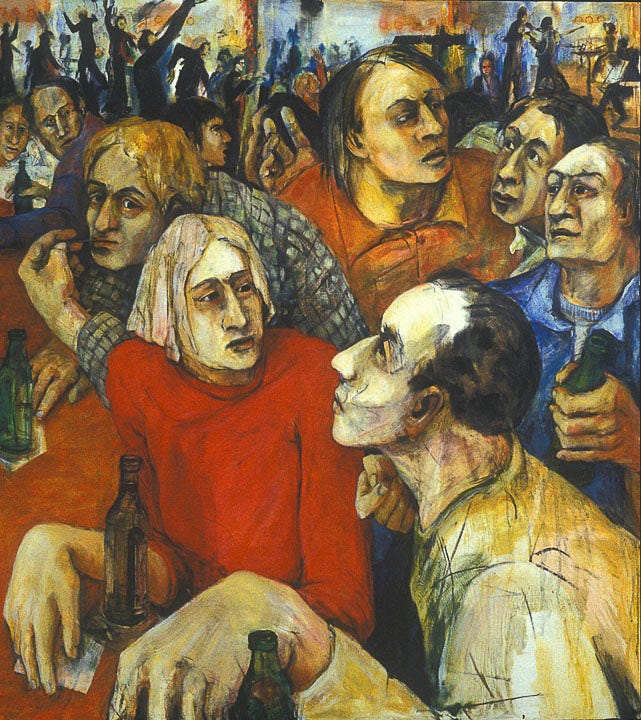
Eve’s bar/interior scene operates through mass and gravity. The figures are compressed into the foreground almost sculpturally. Faces are elongated and exhausted; hands become oversized emotional instruments. The palette is earthen and nicotine-stained: reds, ochres, browns, dirty blues. Everything feels heavy, fixed, and trapped inside social ritual. The composition pushes inward toward psychic pressure. Even the background crowd reads like a rising wall of noise and intoxication. The painting belongs to a lineage of social expressionism concerned with barroom alienation, urban fatigue, and collective loneliness.
Solomon’s work translates some of those same emotional conditions into a much more fluid, distributed, intermedia language.
Eve’s work is centripetal. Solomon’s is centrifugal.
Eve locks bodies together into dense emotional knots. Solomon disperses energy across the surface like signal traffic or musical notation. Figures drift in and out of legibility. Instead of sculptural weight, Solomon uses velocity and recurrence.
The most important structural difference is the role of systems.
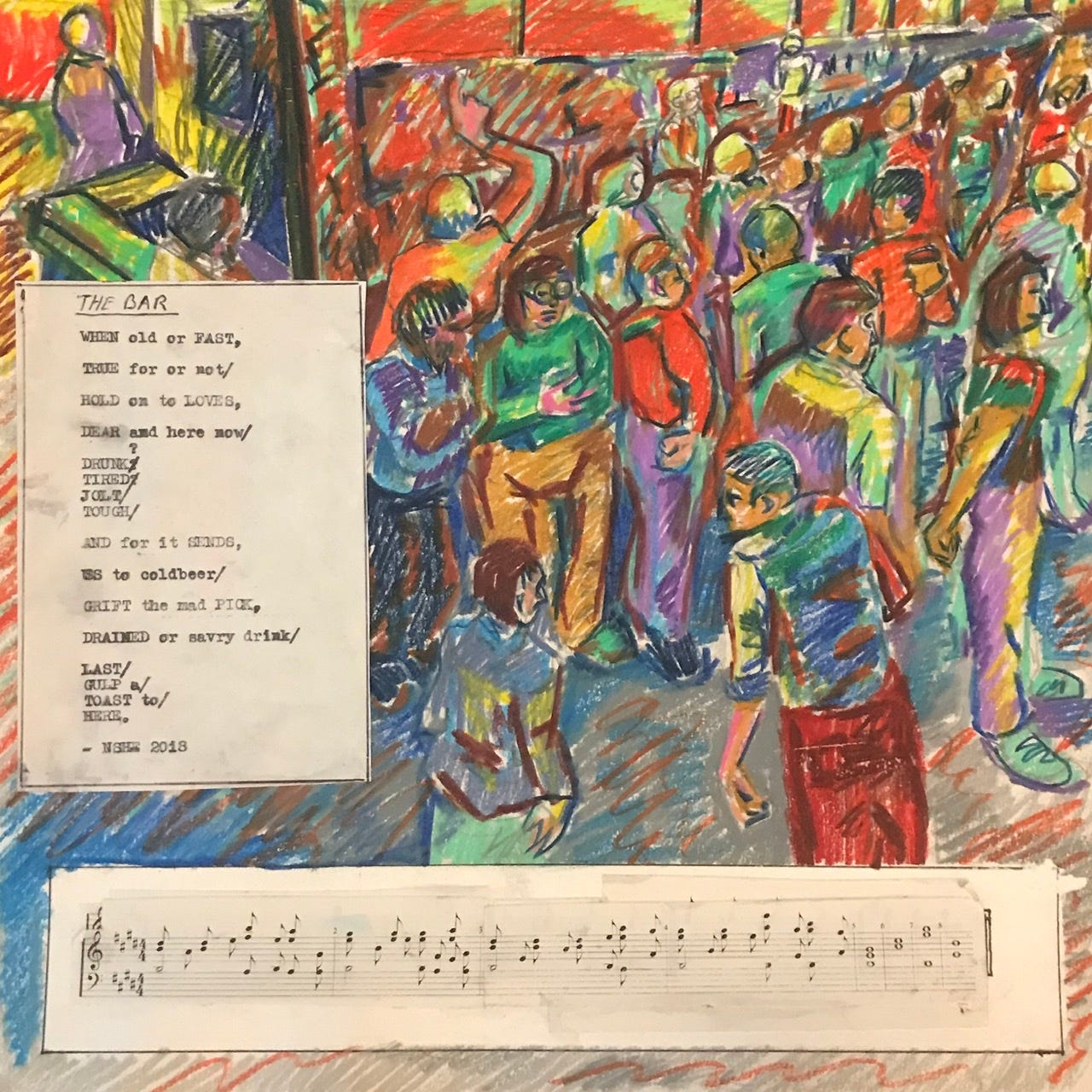
In Solomon’s work, the typed poem, musical staff, repeated figures, color rhythms, and directional marks operate as simultaneous organizational systems. The crowd becomes a murmuration rather than a congregation. The bar is no longer simply a social setting; it becomes a score-space.
The inserted text panel radically changes the ontology of Solomon’s image. In Eve’s work, emotion is embodied primarily through facial and bodily distortion. In Solomon’s, language introduces another register of consciousness. The poem behaves almost like a pinned note, diary fragment, or conceptual anchor interrupting the swarm. Likewise, the musical strip at the bottom functions less illustratively than structurally: it stabilizes the composition horizontally while implying temporal sequencing.
Their handling of color is also fundamentally different. Eve uses color to deepen mood and corporeality. Solomon intentionally destabilizes local color through green skin, violet shadows, orange and red atmospheric flooding, and cyan interruptions. This creates perceptual flicker rather than psychological density. The eye cannot settle. This aligns closely with Solomon’s broader Murmurations logic: pattern accumulation under pressure.
One thing Eve’s work arguably does more powerfully is establish focal hierarchy. It has a brutal clarity about where emotional intensity resides. The central cluster—especially the pale male figure leaning upward—anchors the entire composition psychologically. Solomon sacrifices some of that singular emotional concentration for distributed movement and simultaneity.
What strengthens Solomon’s work considerably is that its apparent looseness is counterbalanced by embedded systems: typed cadence, notation, recurring gestures, directional movement, and chromatic repetition. Without those systems, the image could collapse into improvisational chaos. With them, it acquires an internal rhythm analogous to contemporary music composition or graphic scoring.
Thematically, both Eve and Solomon deal with collective states: intoxication, exhaustion, ritual gathering, social performance, and emotional estrangement. But Eve presents these primarily as existential and social conditions. Solomon presents them increasingly as flows—people becoming moving motifs within overlapping visual, textual, and musical systems.
The result is less tragic and more unstable: less fixed despair, more accelerated psychic weather.
Comparative Critique
The dialogue between Eve and Solomon becomes most interesting when the works are viewed not simply as expressionistic crowd scenes, but as two different solutions to the problem of picturing collective emotional experience.
Eve achieves force through condensation.
Solomon achieves force through circulation.
Eve’s Painting
Eve’s painting is psychologically oppressive in a highly controlled way. Nearly every formal decision reinforces entrapment: compressed foreground space, oversized hands, tilted heads, repetitive facial elongation, tightly packed bodies, and shallow depth.
The figures feel locked into proximity without intimacy. They are physically close but emotionally isolated. The bar setting becomes almost ecclesiastical—a place of ritualized despair.
One of the painting’s greatest strengths is its emotional concentration. The central figures operate like a chamber of pressure. The pale faces are modeled with enough anatomical solidity that their distortion feels consequential rather than decorative. Eve also understands how to vary density: dark crowd masses, pale facial planes, the warm table field, and punctuating bottle forms establish a strong compositional spine.
The limitation of this approach is that its symbolic vocabulary is comparatively concentrated. Once the emotional register of alienation, exhaustion, and intoxicated social theater is established, the painting largely remains within it. Its psychological temperature is sustained rather than elastic.
It is a powerful closed system.
Solomon’s Work
Solomon’s piece is structurally more dispersed and intermedial. It attempts to hold drawing, poetry, notation, crowd choreography, chromatic improvisation, and archival fragmentation within a single image field.
Its strongest aspect is the way the crowd behaves like distributed notation. Figures repeat almost as rhythmic units rather than fully individuated characters. Solomon is less concerned with portrait psychology than with energetic mapping.
The poem and musical staff are not merely collage elements; they alter the mechanism through which the image is read. The viewer oscillates between reading, scanning, internally hearing, and navigating spatial movement. That multimodal behavior is central to the work.
Color performs similarly complex labor. Rather than describing natural light, acidic greens, vibrating oranges, purples cutting through flesh, and unstable blues produce emotional interference patterns. The effect suggests multiple emotional moments occupying the same surface simultaneously.
Solomon’s work is strongest in its rhythmic surface intelligence, movement, integration of systems, atmosphere of psychic overflow, resistance to fixed focal hierarchy, and transformation of social space into score-space.
Seen together, Eve and Solomon are not simply making variations on the same kind of figurative painting. Eve compresses the social body until psychological pressure emerges from it. Solomon takes that social body and disperses it into rhythm, language, notation, repetition, and movement.
The connection is therefore not primarily stylistic. It is structural and familial: two artists using figuration to ask what happens to the individual when bodies, emotions, and social forces accumulate in the same field.